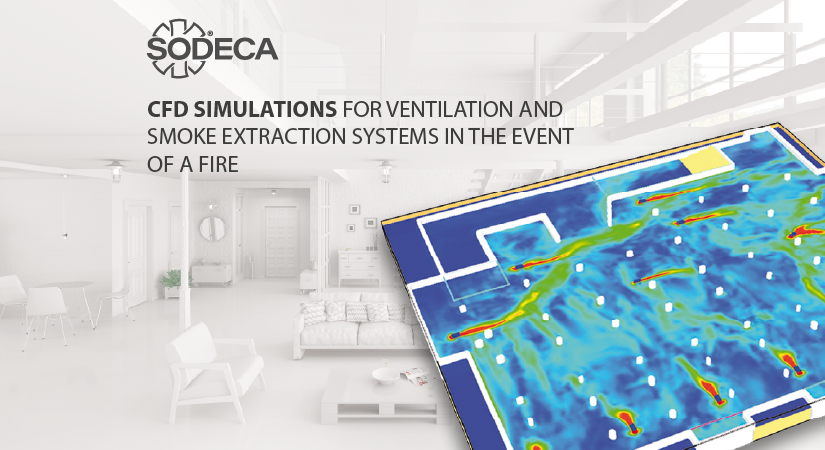
Is it possible to assess whether a ventilation system will operate correctly in the event of a fire before a building is constructed?
When a fire occurs, smoke and hot gases pose significant risks to people's safety. Their rapid spread can reduce visibility, hinder evacuation and compromise the intervention of emergency services.
For this reason, during the design phase of a project, it is essential to verify that the ventilation system will be capable of effectively extracting smoke before the building is constructed.
How can smoke behaviour be predicted and system performance assessed before a building is constructed?
CFD (Computational Fluid Dynamics) simulations make this analysis possible. CFD is an engineering discipline that uses physical and mathematical models, together with computational tools, to virtually simulate the behaviour of fluids, such as air, smoke and gases, enabling system performance to be assessed before construction.
This technology allows engineers to digitally recreate the conditions that would occur inside a building under different scenarios, providing a three-dimensional representation of airflow behaviour without the need for physical testing.
In the field of fire ventilation and smoke extraction, CFD simulations have become a valuable design support tool, enabling system behaviour to be studied before construction and contributing to the development of more efficient and safer solutions.
How do CFD simulations contribute to compliance with the UNE 100166 standard?
The recent revision of the UNE 100166 standard reinforces the importance of verifying ventilation system performance from the design phase. This update introduces new criteria for the design of car park ventilation systems, covering both smoke extraction in the event of a fire and ventilation for air quality.
In this context, CFD simulations make it possible to analyse smoke movement and airflow patterns under different scenarios, optimise the design of impulse ventilation systems and provide technical criteria for developing solutions aligned with the requirements established by the standard.
What is a CFD simulation used for?
A CFD simulation allows engineers to assess ventilation system performance from the design phase, helping to identify potential improvements before project implementation. This allows the solution to be optimised from the outset and minimises the need for modifications at later stages.
With this information, designers can compare different alternatives, analyse their performance and select the most suitable solution for each installation. As a result, occupant safety can be improved while helping to create safer conditions for emergency services during their intervention.
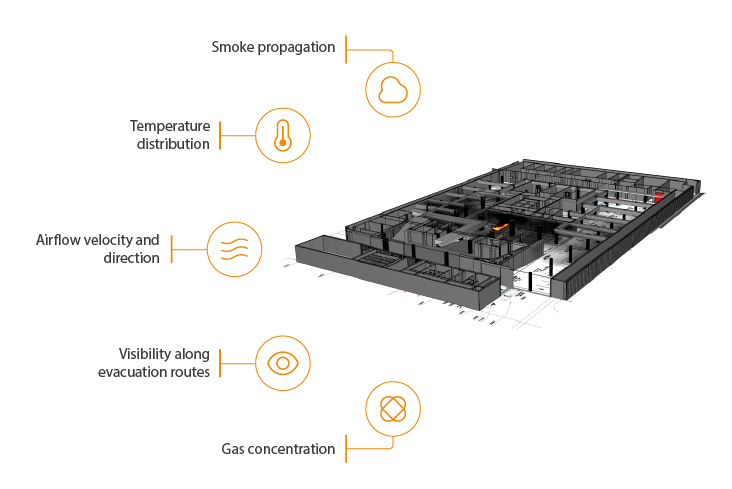
Which parameters should be analysed using CFD simulations when designing ventilation and smoke extraction systems?
To optimise system efficiency, CFD simulations are used to analyse various parameters that help assess smoke behaviour inside a building during a fire, taking into account the operation of the ventilation system. The main parameters include:
- Smoke propagation.
- Airflow velocity and direction to verify effective smoke clearance.
- Areas of stagnant air that hinder smoke dilution.
- High air velocities that could compromise evacuation.
The combined analysis of these factors provides valuable information to optimise ventilation system design, verify its performance under different scenarios and support decision-making throughout project development.
How does SODECA use CFD simulations?
At SODECA, CFD simulations form part of the engineering services provided to support customers, engineering firms and designers during the design phase. To this end, we have advanced computational simulation tools and the technical expertise required to analyse system behaviour under different scenarios and verify that it meets the expected operating parameters.
This service makes it possible to assess the performance of proposed solutions, compare different alternatives and provide technical criteria for defining the most suitable ventilation system for each project.
Furthermore, CFD simulations are complemented by other design support tools, including calculation tools, BIM models and technical resources, providing comprehensive support throughout the entire project development process.